Home
/ Example Of Adverb Of Time - Lesson 1 Adverbs Place, Time, Manner - Lessons - Blendspace - An adverb or adverb phrase is a workhorse in the world of grammar, changing and enhancing the meaning of the accompanying verbs, adjectives, or adverbs.
Example Of Adverb Of Time - Lesson 1 Adverbs Place, Time, Manner - Lessons - Blendspace - An adverb or adverb phrase is a workhorse in the world of grammar, changing and enhancing the meaning of the accompanying verbs, adjectives, or adverbs.
Example Of Adverb Of Time - Lesson 1 Adverbs Place, Time, Manner - Lessons - Blendspace - An adverb or adverb phrase is a workhorse in the world of grammar, changing and enhancing the meaning of the accompanying verbs, adjectives, or adverbs.. An adverb is a word that is used to change, modify or qualify several types of words including an adjective, a verb, a clause, another adverb, or any other type of word or phrase, with the exception of determiners and adjectives, that directly modify nouns. Examples of adverb of time: She came at around 9.30 am. A good way to understand adverbs is to think about them as the words that provide context. You will continue driving north until you see a stop sign.
Adverb clauses are groups of words that function as an adverb. An adverb clause is a group of words that function as an adverb in a sentence. The adverb "loudly" in the 2nd sentence modifies the verb "sing" by giving us more information that the song is sung with a loud voice. I slept late the previous night. The adverbial clause is acting as an adverb in this sentence.
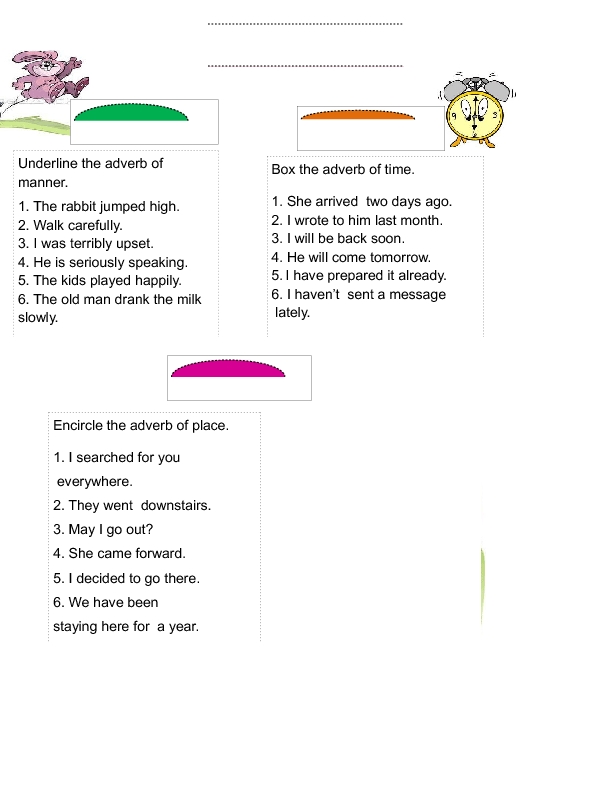
Adverbs of Manner, Time and Place from busyteacher.org As you read the following adverb clause examples, you'll notice how these useful phrases modify other words and phrases by providing interesting information about the place, time, manner, certainty, frequency, or other circumstances of activity denoted by the verbs or verb phrases in the sentences. Adverb clauses are groups of words that function as an adverb. The adverbial clause contains a subject and verb, "you will continue." however, it cannot stand alone as a complete thought. She stayed for a while then left. She came at around 9.30 am. Adverb clauses may be reduced only if the subject of both the dependent (the adverb clause) and independent clause are the same. An adverb is a word that modifies (gives more information about) a verb in a sentence. Examples of adverb of time:
Adverb clauses may be reduced only if the subject of both the dependent (the adverb clause) and independent clause are the same.
To identify adverb clauses, you'll need to understand what an adverb does as well as how a clause is formed. However, adverbs should be used sparingly. Adverb clauses may be reduced only if the subject of both the dependent (the adverb clause) and independent clause are the same. As you read the following adverb clause examples, you'll notice how these useful phrases modify other words and phrases by providing interesting information about the place, time, manner, certainty, frequency, or other circumstances of activity denoted by the verbs or verb phrases in the sentences. An adverb is a word that modifies (gives more information about) a verb in a sentence. When you use multiple adverbs, you risk alienating your reader with dense prose that's too difficult to read. Adverb clauses are groups of words that function as an adverb. An adverb is a word that is used to change, modify or qualify several types of words including an adjective, a verb, a clause, another adverb, or any other type of word or phrase, with the exception of determiners and adjectives, that directly modify nouns. The adverbial clause contains a subject and verb, "you will continue." however, it cannot stand alone as a complete thought. The simple past is also frequently used to talk about past habits and generalizations. While adverb clauses are slightly more. She is singing a song. You will continue driving north until you see a stop sign.
The adverb "loudly" in the 2nd sentence modifies the verb "sing" by giving us more information that the song is sung with a loud voice. I slept late the previous night. Adverb clauses are groups of words that function as an adverb. Examples of adverb of time: An adverb clause is a group of words that function as an adverb in a sentence.
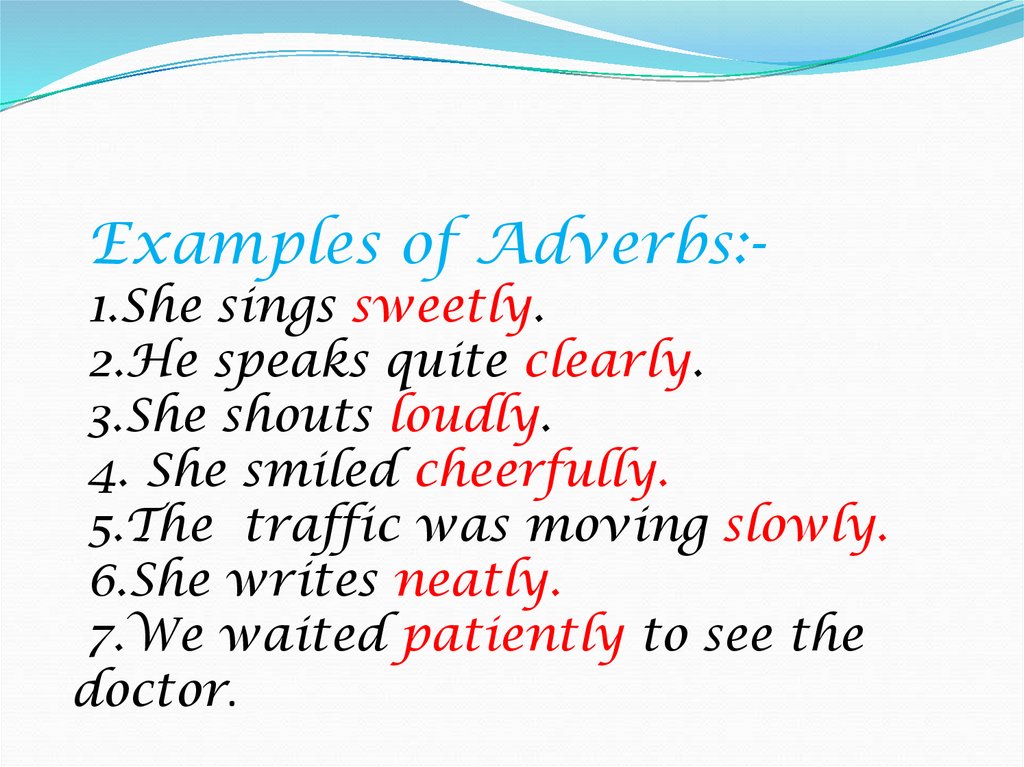
Types of Adverb 🦠 Adverb Examples [All You Need ... from www.myenglishteacher.eu An adverb is a word that is used to change, modify or qualify several types of words including an adjective, a verb, a clause, another adverb, or any other type of word or phrase, with the exception of determiners and adjectives, that directly modify nouns. Adverb clauses are groups of words that function as an adverb. Aug 23, 2019 · reduced adverb clauses refer to the shortening of an adverb clause to an adverbial phrase of time, causality, or opposition. The clause can modify or describe verbs, adverbs, and adjectives.in general, adverb clauses add information that elaborates on when, where, why, how, how much or under what condition the action in the sentence takes place. She came at around 9.30 am. The simple past is also frequently used to talk about past habits and generalizations. She is singing a song loudly. The adverbial clause modifies how you will drive.
Definition of adverb of time:
The adverbial clause modifies how you will drive. However, adverbs should be used sparingly. She came at around 9.30 am. A word that tells the time of an action is called adverb of time. An adverb is a word that is used to change, modify or qualify several types of words including an adjective, a verb, a clause, another adverb, or any other type of word or phrase, with the exception of determiners and adjectives, that directly modify nouns. A good way to understand adverbs is to think about them as the words that provide context. The clause can modify or describe verbs, adverbs, and adjectives.in general, adverb clauses add information that elaborates on when, where, why, how, how much or under what condition the action in the sentence takes place. Adverb clauses are groups of words that function as an adverb. You will continue driving north until you see a stop sign. I slept late the previous night. The adverb "loudly" in the 2nd sentence modifies the verb "sing" by giving us more information that the song is sung with a loud voice. She is singing a song. The simple past (also called past simple, past indefinite or preterite) is a verb tense which is used to show that a completed action took place at a specific time in the past.
The adverbial clause modifies how you will drive. To identify adverb clauses, you'll need to understand what an adverb does as well as how a clause is formed. The simple past is also frequently used to talk about past habits and generalizations. She came at around 9.30 am. I slept late the previous night.
Adverbs - презентация онлайн from cf3.ppt-online.org Definition of adverb of time: Adverb clauses may be reduced only if the subject of both the dependent (the adverb clause) and independent clause are the same. An adverb or adverb phrase is a workhorse in the world of grammar, changing and enhancing the meaning of the accompanying verbs, adjectives, or adverbs. The adverb "loudly" in the 2nd sentence modifies the verb "sing" by giving us more information that the song is sung with a loud voice. The clause can modify or describe verbs, adverbs, and adjectives.in general, adverb clauses add information that elaborates on when, where, why, how, how much or under what condition the action in the sentence takes place. Adverb clauses are groups of words that function as an adverb. I slept late the previous night. The simple past (also called past simple, past indefinite or preterite) is a verb tense which is used to show that a completed action took place at a specific time in the past.
An adverb clause is a group of words that function as an adverb in a sentence.
Definition of adverb of time: A word that tells the time of an action is called adverb of time. Adverb clauses are groups of words that function as an adverb. The adverbial clause is acting as an adverb in this sentence. The simple past (also called past simple, past indefinite or preterite) is a verb tense which is used to show that a completed action took place at a specific time in the past. She stayed for a while then left. A good way to understand adverbs is to think about them as the words that provide context. An adverb is a word that is used to change, modify or qualify several types of words including an adjective, a verb, a clause, another adverb, or any other type of word or phrase, with the exception of determiners and adjectives, that directly modify nouns. As you read the following adverb clause examples, you'll notice how these useful phrases modify other words and phrases by providing interesting information about the place, time, manner, certainty, frequency, or other circumstances of activity denoted by the verbs or verb phrases in the sentences. You will continue driving north until you see a stop sign. I slept late the previous night. The adverb "loudly" in the 2nd sentence modifies the verb "sing" by giving us more information that the song is sung with a loud voice. An adverb clause is a group of words that function as an adverb in a sentence.